

The 2026 overtime rule changes
The U.S. Department of Labor (DOL) finalized new rules regarding federal overtime pay, set to take effect on July 1, 2026. These aren’t predictions about the future; they are changes already in motion that will impact millions of workers. The biggest shift? A significant increase to the salary threshold required for exemption from overtime pay. This means more employees will be eligible to receive overtime pay for hours worked over 40 in a workweek.
Right now, the salary basis test decides if you get overtime. You usually need a set salary and specific job duties to be exempt. This update mostly raises the salary floor. Just because you have a salary doesn't mean you lose out on overtime pay; what you actually do at your desk is what matters.
Employers are already bracing for these changes. Many are conducting internal audits to assess which positions will be affected and determining their strategy – whether that's increasing salaries, reclassifying jobs, or more closely monitoring employee hours. The DOL estimates that over 4 million workers will become newly eligible for overtime under the 2026 rule. This is a substantial change, and workers should familiarize themselves with the new standards.
New salary thresholds for 2026
The new standard salary level will be $58,656 per year, which translates to $2,805.77 per 40-hour workweek. This is a considerable jump from the current threshold of $35,568 per year. Anyone earning below this amount will be entitled to overtime pay at a rate of 1.5 times their regular pay rate for hours worked over 40 in a week.
To put this into perspective, imagine an administrative assistant currently earning $40,000 annually. Under the new rule, they would become eligible for overtime. Similarly, certain retail managers, assistant managers, and even some entry-level supervisors could also find themselves newly covered by overtime regulations. It’s not just about the job title; it’s about the salary.
This hits employees who are currently misclassified. Many businesses use salary as a shortcut to avoid paying overtime, but the DOL is pushing back. This rule is a way to get extra pay to more people.
The duties test still matters
Meeting the salary threshold isn’t enough to be exempt from overtime. The DOL’s "duties test’ is equally important. This test examines the primary duties performed by an employee. To be considered exempt, an employee"s primary duty must fall into one of three categories: executive, administrative, or professional.
An executive typically manages the enterprise or a department, supervises two or more full-time employees, and has the authority to hire or fire. An administrative employee’s primary duty is performing office or non-manual work directly related to the management or general business operations. A professional employee possesses specialized knowledge and often holds a degree or certification in their field.
A common misunderstanding is that a high salary automatically equates to exemption. Someone earning $60,000 a year but spending the majority of their time on routine, manual tasks – like data entry or scheduling appointments – would likely not meet the duties test and would be eligible for overtime. The focus is on the actual work performed, not just the title or pay.
Who remains exempt
While the new rule expands overtime eligibility, certain employees remain exempt. These include "highly compensated employees," defined as those earning over $132,908 per year. They must also customarily and regularly perform at least one duty meeting the duties test.
Certain computer employees also have specific exemption criteria, often related to their job duties and level of skill. This typically covers software developers, systems analysts, and similar roles. Finally, employees in bona fide executive, administrative, and professional roles – as defined by the duties test – will continue to be exempt, even if their salaries fall within the new threshold.
For high earners, total compensation is what counts. Bonuses and commissions help you reach that $132,908 mark. I've seen some confusion here, but the DOL is strict about which specific payments actually count toward the total.
Federal Overtime Exemption Categories - Requirements (as of February 2024)
| Exemption Category | Primary Duty | Salary Basis Requirement | Additional Requirements |
|---|---|---|---|
| Executive | Managing the enterprise or a customarily recognized department or subdivision of the enterprise. | Must be paid on a salary basis. | Customarily and regularly directs the work of two or more other full-time employees or their equivalent; has the authority to hire, fire, or effectively recommend such action. |
| Administrative | Performing office or non-manual work directly related to the management or general business operations of the employer or customer. | Must be paid on a salary basis. | Primary duty includes the exercise of discretion and independent judgment with respect to matters of significance. |
| Professional | Performing work requiring advanced knowledge in a field of science or learning. | Must be paid on a salary basis. | Advanced knowledge is customarily acquired by a prolonged course of specialized intellectual instruction. Examples include lawyers, doctors, accountants, engineers, and teachers. |
| Highly Compensated | Performing executive, administrative, or professional duties. | Must be paid a total annual compensation of at least $107,432 (as of January 1, 2024). | Customarily and regularly performs any one of the duties of an executive, administrative, or professional employee. |
| Computer Employee | Employed as a computer systems analyst, programmer, software developer, or similar. | Must be paid on a salary or fee basis at a rate not less than $684 per week (equivalent to $35,568 annually). | Primary duty consists of the application of systems analysis techniques and procedures to the development, operation, or implementation of computer systems. |
Illustrative comparison based on the article research brief. Verify current pricing, limits, and product details in the official docs before relying on it.
How companies are responding
Companies are taking a variety of approaches to prepare for the 2026 changes. I’m hearing from contacts in HR that many are conducting detailed job descriptions reviews, carefully analyzing the duties of each position to determine if they meet the exemption criteria. This is a time-consuming process, but essential for compliance.
Another common response is increasing salaries to meet the new threshold. This can be a costly option, particularly for smaller businesses. Some companies are also considering reclassifying positions, shifting employees from salaried to hourly status. Others are implementing stricter time-tracking systems and limiting overtime opportunities.
There’s also a lot of discussion about the potential impact on employee morale. Some fear that reclassifying employees as non-exempt could be seen as a demotion, even if it simply reflects their actual job duties. Employers are trying to navigate these changes carefully to avoid negative consequences.
Tax impact of higher pay
Increased overtime pay will affect your taxes. The IRS recently introduced a new deduction for qualified overtime compensation, as of the 2023 tax year (see irs.gov for details). This allows qualified workers to deduct up to $2,000 in overtime pay from their gross income.
Overtime pay is still taxable income. If your earnings jump, you might land in a higher tax bracket. That means the government takes a bigger bite out of those extra hours.
It’s always a good idea to consult with a tax professional to understand the specific implications of increased overtime pay on your individual tax situation. They can help you maximize your deductions and minimize your tax liability.
State laws vs. federal rules
Federal law sets a minimum standard for overtime pay, but states can – and often do – have more generous rules. This means that in some states, you may be entitled to overtime pay even if you earn above the federal salary threshold.
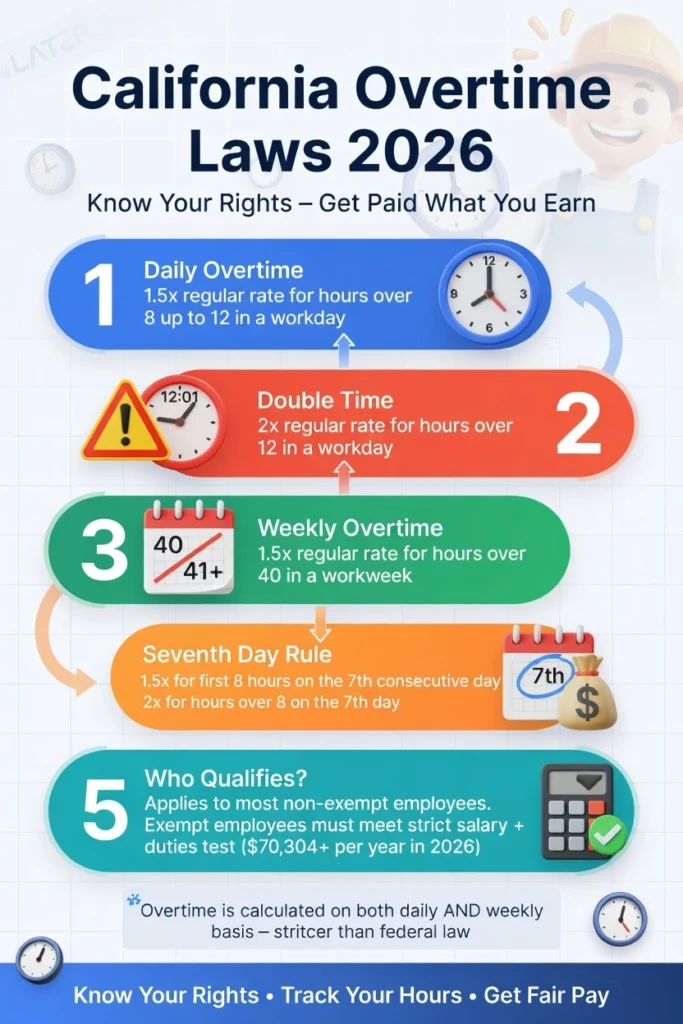
California and New York, for example, have significantly higher salary thresholds for overtime exemption. These states also often have broader protections for workers, covering more job categories and offering more flexible overtime rules. It’s vital to check your state’s labor laws to understand your rights.
Workforce.com provides a useful state-by-state overview of overtime pay laws (workforce.com). Always prioritize your state’s regulations, as they will supersede federal law if they offer greater protection to workers. Knowing your rights is the first step to ensuring you're paid fairly.
No comments yet. Be the first to share your thoughts!